Monday, April 26, 2010

CUDA PTX Extraction

by Travis Goodspeed <travis at radiantmachines.com>
concerning CUDA 3.x on Darwin
as the first of several CUDA articles.

The following are some brief introductory notes on dumping PTX kernels from modern CUDA applications, as well as techniques for embedding them within new applications. One or two copies of every shader are stored as ASCII strings within each CUDA executable by default. With a little ingenuity, the contents of this article and a decent machine with a G80 card should provide a decent start in reverse engineering general-purpose GPU applications.

Nvidia's CUDA framework for GPU computing uses a portable meta-assembly language, PTX (ptx_isa_2.0.pdf), to facilitate translation between multiple GPU devices. In this manner, they can escape the backward compatibility issues that hold most modern CPU architectures to a single instruction set. PTX vaguely resembled the underlying machine code, but it lacks features which would tie it to any particular GPU. In this brief article, I present a trivial method for extracting PTX assembly from CUDA applications, as well as some pointers for merging that code into new applications.

Dumping


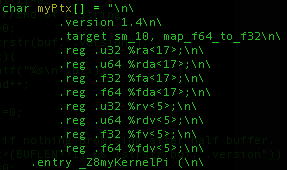
The screenshot below shows a fragment of libcublas.dylib from CUDA 3.0 in Snow Leopard being edited in Emacs. Following the dozens of assembler directives are individual VM opcodes. (This contains Basic Linear Algebra Subprograms. As this comes from Fortran, not C, the code is a bit weird.) By default, CUDA will compile inline code in a language similar to C into PTX assembly, then include the PTX assembly string verbatim into the resulting executable or library. User comments are not preserved, but compiler comments are introduced and names are unaltered. Except where hand-written, the compiler will always be nvopencc.
CUDA PTX Extraction

The nvopencc compiler has a number of quirks when writing PTX:
  • Every line that is not a label is tabbed in at least once.
  • The first directive is .version, the second is .target.
  • Registers are declared in groups.
  • Names are preserved, with C++ mangling.

Further,
  • Every PTX script ends with a null (0x00) byte.
  • While they can be big, no PTX script is larger than two megabytes.
  • PTX scripts come in pairs, one for sm_20 and another for sm_10.


To dump the PTX code from a binary, Mach-O executable, just scan the input for long strings, printing everything starting with "\t.version". In my own setup, I have an ugly C program that prints these, passing them off to the unix split command for separation into multiple PTX files.

The 312 PTX scripts from CUBLAS are mostly small, with only nine of them having source in excess of a megabyte but none being larger than two megabytes. Thus, you'll need a rather long string buffer. Additionally, it is handy to purge the buffer when no fragment of a PTX executable is found and whenever a null byte is encountered. You can find the PTX from the vectorAdd example at http://pastebin.com/nqKqKhNc.

Applications can be compiled without PTX inclusion, using machine-language CUBIN files instead. This has the disadvantage of not being forward-compatible, and thanks to Wladimir J. van der Laan's Decuda project, it isn't much more difficult to read.

To try this out yourself, first build a dumping script based upon the CUDA examples and libraries. Once you have that, try downloading a few of the more advanced demos. The Nvidia Graphics Plus demos might be a good target, as would any game advertising CUDA support.

PTX JIT


Having dumped a PTX script, it is handy to link it back into an existing project. For this, you will want to use the matrixMulDynlinkJIT or ptxjit examples that come with the CUDA development kit. These projects use the cuModuleLoadDataEx() method to link a PTX script from a string, then cuModuleGetFunction() to grab a CUfunction pointer to any function.

Conveniently, the PTX scripts include symbol names, but as with any complex compiler, these have been somewhat mangled. In the addVector example, the entry point hask been mangled to _Z6VecAddPKfS0_Pfi for both sm_10 and sm_20. It is this function name, and not the simpler VecAdd, that must be passed to cuModuleGetFunction().

This is the code that the ptxjit example uses to load a kernel named _Z8myKernelPi kernel contained within the myPtx[] character array. Looking at the string itself, which is defined within ptxjit.h, it can be seen that the code was rather hastily dumped by a method similar to the one I describe above.
PTX JIT
myPtx from PTXJIT

Caveats


GPU programming is sufficiently confusing when source code is available that the lifting of code oughtn't be a concern. Generally only small fragments are executed within the GPU, with the majority of development time being spent debugging those fragments and twisting them for different physical optimizations.

Daniel Reynaud's talk on GPU Powered Malware at Ruxcon 2008 proposed that GPU programs might be useful for malware URL generation. It goes without saying that sophisticated malware will do better than to include an unencoded ASCII string. Pre-assembled bytecode can be provided directly to the card, avoiding the inclusion of a PTX string. While some of Reynaud's points are less relevant now that CUDA has debugging and bytecode emulation, the core of his argument that GPU packers will become important is still valid. For starters, it is possible use a pegged memory segment to have GPU code rewrite host X86 code on the fly without a context switch!

Expect some follow-up articles on the neighborly things that can be done once your hands are inside the beast that is CUDA.

Wednesday, March 24, 2010

Smartgrid Skunkworks

Dearest engineers and hackers, and also their management,

Recent vulnerabilities found in smart meters and HAN devices have shown a number of weaknesses in the engineering practices used to build these devices and their constituent components. A vulnerability in a chip or library is fixed slowly, and it is a very rare event that the meter and thermostat vendors affected by the vulnerability are notified by their suppliers. Because of this, vulnerabilities are spreading downward through the supply chain, and the engineers of smart grid devices are left uninformed.

While those utilities that actively investigate security have a considerable amount of bargaining power with their immediate suppliers, the rest of the supply chain has no similar leverage to compel security notifications. Chip and library vendors are failing to notify the meter vendors that depend upon their components. Even when the meter vendors are notified directly of vulnerabilities, thermostat and other HAN vendors can have no realistic expectation of such a privilege.

Despite having found many vulnerabilities in microcontrollers and LPAN radio chips, I have never seen one single security issue mentioned in the errata sheets of these devices. It has been a year since I first reported to Texas Instruments that the RAM of their Chipcon 8051 core is exposed to an attacker, but there's not one scrap of documentation from the firm to its customers suggesting that they make the simple patch of moving the key variables to Flash memory. The example ZigBee stack for the chip is still vulnerable to this attack, even after recent patches! A year later, exactly two debugger commands are all that are required to extract keys from nearly every ZigBee SEP device with a Chipcon radio, and no one knows to patch their code! (Do not be smug if you are an Ember customer. The EM2xx chips are unpatchably vulnerable to debugger key extraction, and there is no mention of this in the chip's errata sheet either.)

As chip and library vendors have failed to document the publicly known vulnerabilities in their products, and as they have often been unable or unwilling to repair them, the most expedient remedy to this problem is a separate line of communication. At least one point of reference must exist for the engineers trying to build these products.

For these reasons, I have created a skunkworks mailing list for the announcement and discussion of smart grid vulnerabilities, particularly but not exclusively those in AMI equipment. This is to be a list for engineering discussion, by engineers and security researchers. Anonymous posts and lurking are welcome, but politics and committee items are not.

For this reason, I especially request that those firms which care about security ask--or perhaps even require--their engineering staff to subscribe. This list is the appropriate place to post questions concerning the secure use of a particular radio chip, fragment of code, or anything else which is too low level or vendor-specific to be mentioned in standards.

If your firm is unwilling to allow its engineers to post, please at least compel them to follow the posts of others. In saying nothing, they will still learn how to make more secure products along with all sorts of fascinating gossip about your competitors. Your firm has every right to keep its mouth shut, but keeping its ears shut is a betrayal of each and every one of your customers.

To kickstart this mailing list, I will make it my first site of public disclosure for smart grid vulnerabilities over the coming months. The subscription link is below, and I invite you to join me in preventing smart grid vulnerabilities before they are created.

http://groups.google.com/group/smartgrid-skunkworks

Thank you kindly,
--Travis Goodspeed
Belt Buckle Engineer
Security Hobbyist

Tuesday, March 9, 2010

IM ME GoodFET Wiring Tutorial

by Travis Goodspeed <travis at radiantmachines.com>
concerning the Girltech IM ME,
with a million thanks to Dave.

WARNING: Reflashing the CC1110 while batteries are low will permanently lock the chip. Either be damned sure to use fresh batteries or leave the batteries out and power the IMME from your GoodFET.

Howdy y'all,

This brief tutorial describes the process of reflashing the Girltech IM ME with custom firmware, so that it may be used as a development platform for the Chipcon CC1110 sub-GHz ISM System-on-Chip. I assume the reader to have an assembled GoodFET with recent firmware, but other programmers may of course be substituted.

You should also read Dave's first article on IM ME hacking, as it describes his method for reprogramming the device. All the pinouts below were taken from his articles, as well as the keyboard and LCD information that he was so neighborly as to publish.

Wiring


First, you'll need to purchase an IM ME, which can be had for $20 USD on a few toy sites while it remains in stock. You'll also need an assembled GoodFET and basic electronics tools.

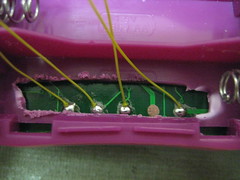
The testpoints used for programming the IM ME are located behind the batteries in the rear compartment of the device. Ideally, a bed of nails should be used to clip into it, but failing that, just solder on to the Debug Data (DD), Debug Clock (DC), Reset (!RST), and GND pins. Run these to the GoodFET's 14-pin header as shown below.

Testpoints
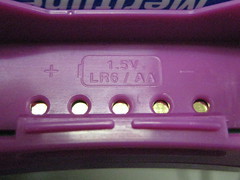
Exposed Testpoints

From left to right on the IM ME, the pins are !RST, DD, DC, +2.5V, and Ground. Because the GoodFET is a low-voltage device, there's no need for the resistor dividers in Dave's article. Use EITHER the GoodFET OR the batteries for VCC, but not both.
NamePin
Name
DD12Vcc

34Vcc
RST56
DC78
GND910

1112

1314


Flashing


Once you have the IM ME wired up, you can check its model number and status by running `goodfet.cc status'. This will tell you that the chip is locked, so making a backup of its firmware is non-trivial. If you continue from here, the IM ME will no longer function as an instant messenger.

Erase the chip by 'goodfet.cc erase' then dump an image of RAM as 'goodfet.cc dumpdata immeram.hex' to see if anything neighborly can be found inside.

You now have a blank IM ME, with the LCD most likely showing the last gasping breaths of its firmware. To flash a new firmware image, just grab its ihex file and run 'goodfet.cc flash foo.hex'.

I've placed a few example binaries in the repository of an operating system that I've started for the IM ME called GoodME. To flash Dave's LCD Test, run the following commands.
svn co https://goodfet.svn.sourceforge.net/svnroot/goodme
goodfet.cc flash goodme/bins/dave-lcdtest.hex


For a more functional demo, try bins/term-morse824mhz.hex, an ugly hack of an operating system for the IM ME with a Morse code transmitter and random number generator demo. In the Radio demo, holding any of the letter buttons broadcasts on 824MHz. The PRNG demo, shown below, demonstrates the repetition of strings withing the psuedo-random number generator and counts the number of bytes between them. This is sometimes used for key material.
CC RNG Test


Custom Development


The SDCC compiler is in the package repositories of most civilized operating systems. You might need a more recent version for the cc1110.h header, though building this compiler is a thousand times simpler than GCC. Compiling an example is as simple as sdcc foo.c; packihx <foo.ihx >foo.hex, which will produce a suitable Intel Hex file for flashing. The 8051 memory model makes specifying a chip model unnecessary, a handy deviation from those of us with a thousand MSP430 linking scripts.

Within the GoodME repository, you'll find my bastard child of an operating system at /branches/rough/. It was used to make the term-morse824mhz.hex, and its keyboard, font, and LCD drivers are ripe for organ transplants. /trunk/ ought to someday contain a proper operating system for the device, but for now, I haven't the time to complete it.

Have fun, and build something neighborly,
--Travis

Sunday, February 21, 2010

XML of SmartRF Studio 7

by Travis Goodspeed <travis at radiantmachines.com>
concerning TI SmartRF Studio 7.

For those who have not personally suffered the experience, choosing radio register values is an absolute pain. In this brief article, I will demonstrate a method for extracting settings in bulk from SmartRF 7 Studio for use in other projects.

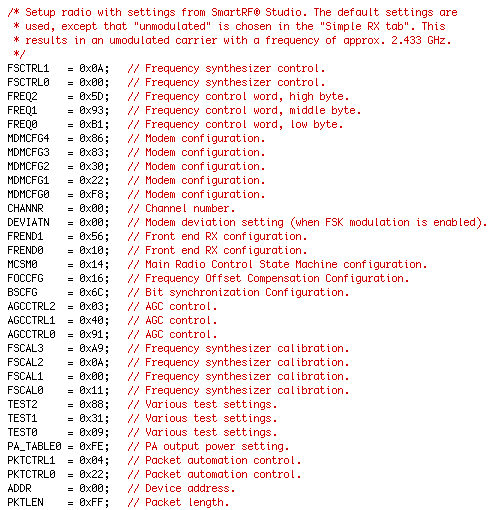
Suppose that a program should configure a CC1110 to operate on a particular frequency, in a particular encoding, etc. The code will like the following, which is from the CC1110 examples. This will generate a carrier wave near 823 MHz, as the 2.433GHz FREQ[] value is outside of the allowed range.

Chipcon Settings

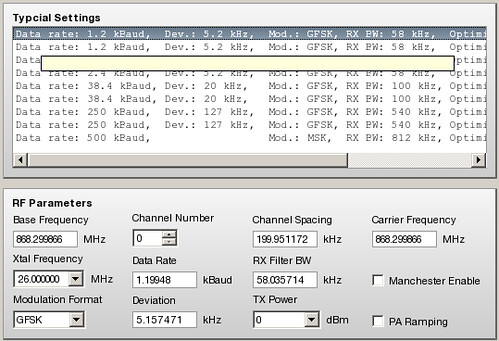
To choose a different center frequency, the engineer is expected to either find the register's definition within the datasheet or use SmartRF Studio, a screenshot of which is below. The software is a Windows application for communicating with a radio through a serial port. It also allows an engineer to load preconfigured profiles for certain types of modulation, such as IEEE 802.15.4 or SimpliciTI. Once loaded, the settings may be tweaked and loaded into a packet-sniffer firmware for debugging projects.

Chipcon Range Limits

The screenshot above, from SmartRF 6, can provide a decent idea of how infuriating the software might become. For product development, the register settings are to be copied and pasted into opaque source files. It can instill the same sort of anger as an uncooperative web form, even after the old Visual Studio 6 libraries have been located to make it work under Wine.

SmartRF 7--at Beta 0.9.1 as of this writing--is a new client under active development, one which seems to have been rewritten from scratch or at least significantly refactored. The old Win32 GUI has been replaced with QT4, making a future Linux or Mac port possible. Most importantly of all, however, is that the default configurations, as well as register explanations, are stored as XML.

SmartRF 7

The screenshot above shows how default configurations are chosen for the target radio. Users can select an example, then change any of the settings they like. These configurations are further abstracted into an "Easy Mode" which hides all the messy minutia of radio, abstracting use to standards and channel numbers.

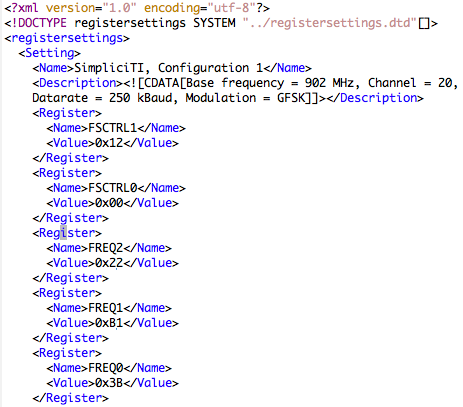
These configuration settings are to be found as XML in the config/xml/ directory, organized by chip and presentation. The following is an example of one such configuration file for the CC1110.
SmartRF 7 XML

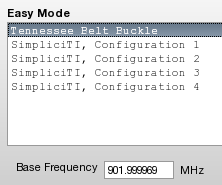
Patching these configurations allows for the easy addition of new standards. For example, I added support for my Tennessee Belt Buckle radio by adding a new stanza to easymode_settings.xml.
SmartRF Belt Buckle

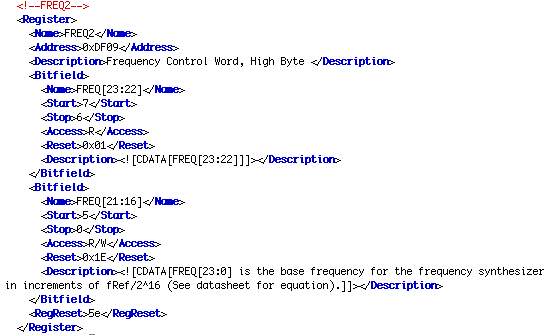
The register definitions and their bitfields are also defined in XML. The following from register_definition.xml for the CC1110 described the FREQ2 register's meaning.
SmartRF 7 XML Register Def

Printing SDCC special-function register definitions, such as those found in cc1110.h, is as easy as a bit of Python magic,

#!/usr/bin/python

# Simple script for dumping Chipcon register definitions to SDCC header.
# Only intended as a rough example.
# by Travis Goodspeed, Engineer of Superior Belt Buckles

import xml.dom.minidom
def get_dom(chip="cc1110",doc="register_definition.xml"):
fn="/opt/smartrf7/config/xml/%s/%s" % (chip,doc);
return xml.dom.minidom.parse(fn)

dom=get_dom();

for e in dom.getElementsByTagName("registerdefinition"):
for f in e.childNodes:
if f.localName=="DeviceName":
print "// %s=%s" % (f.localName,f.childNodes[0].nodeValue);
elif f.localName=="Register":
name="unknownreg";
address="0xdead";
description="";
for g in f.childNodes:
if g.localName=="Name":
name=g.childNodes[0].nodeValue;
elif g.localName=="Address":
address=g.childNodes[0].nodeValue;
elif g.localName=="Description":
if g.childNodes:
description=g.childNodes[0].nodeValue;
print "SFRX(%10s, %s); /* %50s */" % (name,address, description);


These configuration files should allow for new Chipcon radio applications and development tools to be written in short order. Please contact me if you would be so kind as to write a complete Python class for querying this data.

Friday, February 5, 2010

Call for Info Flash

by Travis Goodspeed <travis at radiantmachines.com>
continuing a discussion of MSP430 Info Flash

Neighborly MSP430 developers, please do me a favor and email me the contents of memory from 0x1000 to 0x1100 of every MSP430F2xx device that you can. I'm trying to reverse engineer the exact distributions of the CALBC1_16MHZ and CALDCO_16MHZ values in order to build a UART library that operates without Info Flash. The GoodFET does this well enough, but I still get the occasional bug report when a device is slightly out of range. I can reduce the default to baud rate or try similar tricks to get around this, but I want to know exactly which values are safe.

If your GoodFET can be programmed by goodfet.bsl but does not respond after programming, try the info flash images available in /contrib/infos/ to see if any of them work.
air% goodfet.bsl -e -p 2618-002.txt;\
goodfet.bsl -p ../../trunk/firmware/goodfet.hex
MSP430 Bootstrap Loader Version: 1.39-goodfet-8
Mass Erase...
Transmit default password ...
Invoking BSL...
Transmit default password ...
Current bootstrap loader version: 2.13 (Device ID: f26f)
Program ...
256 bytes programmed.
MSP430 Bootstrap Loader Version: 1.39-goodfet-8
Invoking BSL...
Transmit default password ...
Current bootstrap loader version: 2.13 (Device ID: f26f)
Program ...
10596 bytes programmed.
air% goodfet.monitor peek 1000 100A
1000 55aa
1002 3fff
1004 abcd
1006 55aa
1008 1234
air%


Previously programmed GoodFETs have info flash wiped during programming, but if yours has never been programmed, you can dump the info with
goodfet.bsl --dumpinfo >info.txt

Monday, January 25, 2010

ZStack PRNG Fixed

by Travis Goodspeed <travis at radiantmachines.com>
concerning versions 2.2.2 and 2.3.0 of TI Z-Stack
and a fix of the ZigBee Smart Energy Profile ECC vulnerability.

Texas Instruments has released version 2.3.0 of Z-Stack, their ZigBee stack for the TI/Chipcon CC2530, MSP430, and CC430 chips. The new version adds a variety of new features, but chief among them is a fix to the random number generator which used to be utterly insufficient for cryptographic use. Technical details on the vulnerability were first revealed publicly in my last article. (Nate Lawson's translation is here.)

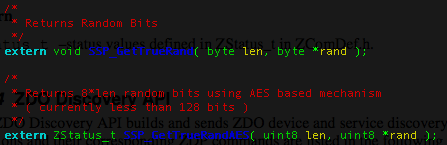
Source code for the new generator is not included, but rather references as a Security Service Provider (SSP). Since 2.2.3, they have extended the SSP API to include SSP_GetTrueRandAES() for generating random numbers by an AES key.

ZStack 2.3.0-1.40 TrueRand Functions

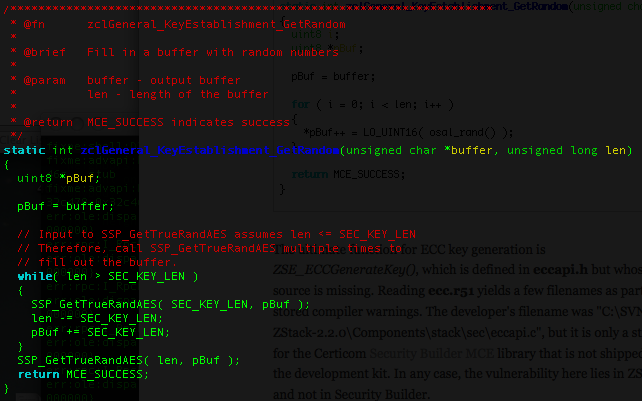
This is then called in zclGeneral_KeyEstablishment_GetRandom(), which in previous versions used the 16-bit LFSR.

ZStack 2.3.0-1.4.0

Authors of firmware for ZigBee Smart Energy devices that have used this code should patch their source code and issue firmware upgrades as quickly as possible. Those with independent crypto implementations should check to ensure that they have not made similar mistakes. Programmers should also note that

Electric utilities with equipment using the MSP430 or Chipcon CC2530 should contact their vendors for such updates. Unlike Windows and Linux, there's no easy way to perform an upgrade of a fragment of microcontroller firmware to which you haven't got the source.

This fix only applies to the remote recovery of keys by PRNG attacks; local key extraction is still possible by the methods that I outlined in Extracting Keys from Second Generation ZigBee Chips.

Saturday, January 9, 2010

PRNG Vulnerability of Z-Stack ZigBee SEP ECC

by Travis Goodspeed <travis at radiantmachines.com>
with neighborly thanks to Nick DePetrillo,
concerning version 2.2.2-1.30 of TI Z-Stack
and a ZigBee Smart Energy Profile ECC vulnerability.

Not Quite Random

In past articles, I've presented a variety of local attacks against microcontrollers and ZigBee radios. While I maintain that local vulnerabilities are still very relevant to ZigBee devices, this article presents a remotely exploitable vulnerability in the way that random keys are generated by TI's Z-Stack ZCL implementation of the ZigBee Cluster Library. Randomly generated numbers--those fed into the Certicom ECC crypto library--are predictable, repeated in one of two 32kB cycles. Details follow, with links to source code and a complete list of random numbers.

Dumping Random Bytes


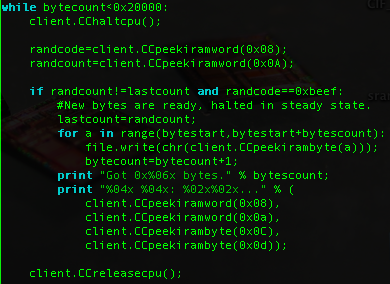
I dumped byte sequences from the CC2430 using the GoodFET to debug a live chip. The chip runs a program which populates IRAM with PRNG bytes, then halts with a soft breakpoint (Opcode 0xA5) for the debugger to grab all sampled values. The main loop looks something like this:
Chipcon RNG Dumper
The firmware was compiled with the Small Device C Compiler, flashed by the GoodFET. A quick Python script then used the GoodFET library to debug the target, dumping random values through the same interface that programmed the chip.
Chipcon Byte Dumper

Short PRNG Period


Page 18 of the CC2530 Datasheet describes the random number generator peripheral, which is shared by all other 8051-based ZigBee SoC devices in the series.
The random-number generator uses a 16-bit LFSR to generate pseudorandom numbers, which can be read by the CPU or used directly by the command strobe processor. The random numbers can, e.g., be used to generate random keys used for security.

The state of this RNG is initialized in the hardware abstraction library by feeding 32 bytes from the ADCTSTH special function register into RNDH register. Bytes read from ADCTSTH are physically random, but poorly distributed. RNDH and RNDL are the High and Low bytes of a 16-bit CRC Linear Feedback Shift Register, the state of which can be advanced by writing to RNDH or overwritten by writing to RNDL. In between reading or writing from RND, the state is advanced by setting the fourth bit of ADCCON1. Detailed descriptions of these registers can also be found within the datasheet.

CC2430 examples randomize the seed by mixing 32 values into the RNG,
for(i=0;i<32;i++){
RNDH=ADCTSTH;
ADCCON1|=0x04;
}

Because these numbers are not evenly distributed, Z-Stack prefers to sample just the least significant bit of the RF random number generator sixteen times, then write them in directly as the state without mixing them. Further, it checks to ensure that the state is not a dead-end, substituting another if it is. This method is also advocated within the CC2530 programming guides.
for(i=0; i<16; i++)
rndSeed = (rndSeed << 1) | (RFRND & 0x01);
if (rndSeed == 0x0000 || rndSeed == 0x0380)
rndSeed = 0xBABE;
RNDL = rndSeed & 0xFF;
RNDL = rndSeed >> 8;


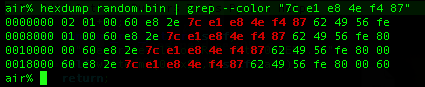
Once the RNG has been seeded, it has an initially random 16-bit state. From then on, however, it produces random bytes in a predictable sequence. Only the starting point is random, as ADCTSTH is never used for future reseeding. As shown in the screenshot above, if the sequence "7c e1 e8 4e f4 87" is observed, the probability of the next bytes being "62 49 56 fe 80 00 60" is 100 percent. Further, because the domain is so small, it can be exhaustively searched for keys in little time.

Not Quite Random

Code for dumping these values through the GoodFET debugger can be found by svn, along with a complete dump of the PRNG sequence.
svn co https://goodfet.svn.sourceforge.net/svnroot/goodfet/contrib/ccrandtest

Seed Values


Seed Histogram

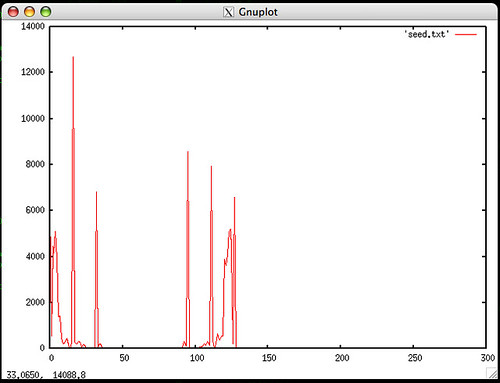
The plot above shows the histogram of radio ADCTSTL values used to seed the PRNG. These are far from random, but when sampled slowly enough, their least significant bit is probably good enough for key generation. There are, however, two things of interest with this.

First, if the crypto library is used infrequently, it would make sense to use this source of entropy instead of the inadequately random PRNG output. There would be a cost in power consumption, as ADCTSTL is only random while the radio is operating, but the resulting increase to security is necessary.

Second, if the peaks on the histogram come from a measurement of the radio, it might be possible to generate a radio signal that forces even the least significant bit to be a predictable value. Steps such as AES whitening should be taken to avoid such an attack.

ZigBee SEP, ECC


A less than perfect random number generator is not much of an issue when symmetric keys are pre-shared, but because pre-shared keys are vulnerable to local attacks, the ZigBee Smart Energy profile recommends the use of session keys signed by elliptic curve cryptography. See the USAF paper Cryptanalysis of an elliptic curve cryptosystem for wireless sensor networks for a prior break of ECC with a poor RNG.

As will be shown in the next section, Chipcon's ZStack makes use of poorly random PRNG data as key material, allowing for a key domain of only 16 bits. This is small enough to be exhaustively searched, either by a PC or by a "Chinese Lottery" of previously compromised wireless sensors.

ZStack Usage


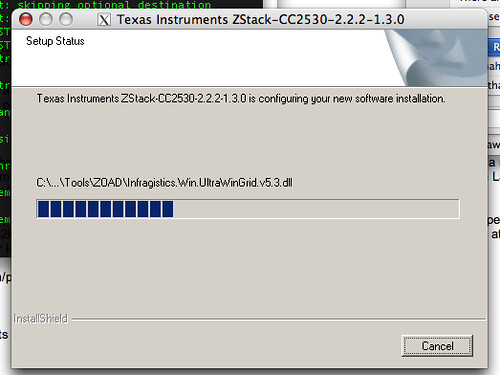
ZStack 2.2.2-1.30 for the CC2530 makes use of the PRNG to implement the Smart Energy Profile's asymmetric cryptography. The Windows installer works perfectly under Wine, leaving ZStack installed to an awkward directory. I symlink it to /opt/zstack for convenience.
CC2530 in Wine

Once installed, the following Functions are of interest.

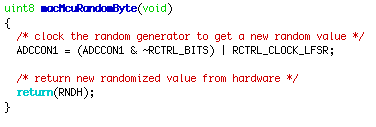
mac_mcu.c contains macMcuRandomByte() and macMcuRandomWord(). As the two are largely the same, take the former for an example. First the PRNG is clocked, then the high byte is sampled.
ZStack macMcuRandomByte()

zcl_key_establish.c is used to generate keys by the ZigBee Cluster Library specification, available for free by form from ZigBee.org. The code fragment below takes the low bytes of macMcuRandomWord(), redefined as osal_rand(), to populate a session key before signature.
ZCL KeyEstablishment GetRandom

The ultimate function for ECC key generation is ZSE_ECCGenerateKey(), which is defined in eccapi.h but whose source is missing. Reading ecc.r51 yields a few filenames as part of stored compiler warnings. The developer's filename was "C:\SVN-ZStack-2.2.0\Components\stack\sec\eccapi.c", but it is only a stand-in for the Certicom Security Builder MCE library that is not shipped with the development kit. In any case, the vulnerability here lies in ZStack and not in Security Builder.

Conclusions


This article has shown that the Chipcon ZStack library, as of version 2.2.2-1.30 for CC2530, uses an insufficiently random PRNG for cryptographic signatures and session keys. PRNG data repeat every 32,767 samples, and there are at most 16 bits of entropy in any key. Searching the entire key space ought to be possible in very little time. Contrary to the CC2530's documentation, these random numbers must not be used to generate random keys used for security.

All users of this library, particularly those using it for Smart Grid devices and other industrial applications, are recommended to re-implement macMcuRandomWord() and to ensure that nothing requiring cryptographic security operates from the PRNG alone. Users of other libraries for the Chipcon devices should ensure that those libraries are not using the PRNG data.

Competing devices and libraries should also be checked for similar vulnerabilities, as well as commercial products such as Smart Meters that might have forked the ZStack code or followed the datasheet's recommendation of using the PRNG for key generation.